
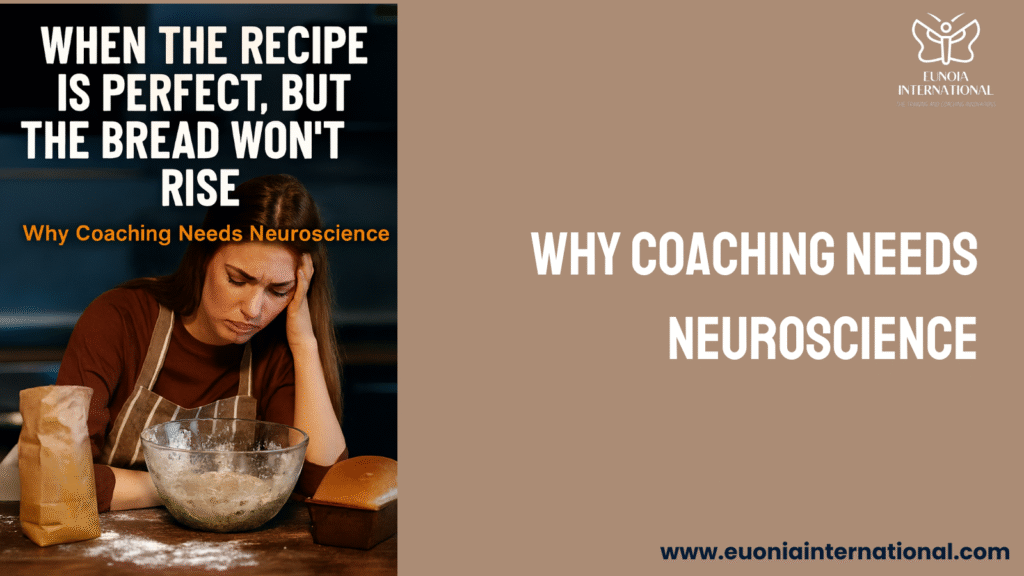
When the Recipe is Perfect, But the Bread Won't Rise: Why Coaching Needs Neuroscience
Imagine you’re learning to bake bread for the first time. You find the perfect recipe online beautiful photos, clear instructions, exact measurements for every ingredient. You read through it carefully. You understand every step. The recipe makes complete sense. You even feel excited about the warm, golden loaf you’re about to create.
But when you actually make the bread, something goes wrong. The dough doesn’t rise. The texture is off. It doesn’t look anything like the picture. Frustrated, you read the recipe again. The instructions haven’t changed. You understood them the first time. So why didn’t it work?
Here’s what the recipe didn’t tell you: bread needs time, warmth, and the right environment to rise. The yeast is a living organism that responds to temperature and moisture. Kneading creates a structure that takes patience to develop. Understanding the recipe intellectually is completely different from knowing how the bread actually transforms.
This is exactly what happens in most coaching conversations today.
The Invisible Architecture of Change
Every time a client walks into your coaching session, they’re not just bringing their goals and challenges. They’re bringing an entire neurological history thousands of repeated thoughts, hardwired emotional responses, and automated behavioral loops that have been firing and wiring together for years, perhaps decades.
The brain is a remarkable recording device. Every experience you’ve ever had, every thought you’ve repeatedly thought, every emotion you’ve consistently felt has left its mark in your neural architecture. These aren’t abstract concepts. They’re physical structures synaptic connections that have been strengthened through repetition until they became the superhighways of your nervous system.
Here’s the profound truth that changes everything about coaching: Your personality creates your personal reality. And your personality is made up of how you think, how you act, and how you feel.
When your client says “I want to be more confident,” what they’re really asking for is to rewire the neural networks that have been automatically firing patterns of self-doubt for years. When they say “I want to stop procrastinating,” they’re asking to break the addiction to the familiar chemicals their body has become accustomed to producing every time they delay action.
The Quantum Field of Possibility
Most coaching operates in the Newtonian world the world of cause and effect, action and reaction, goal and execution. But transformation doesn’t happen in this mechanical realm. It happens in the quantum field, where all possibilities exist simultaneously, where your future self already exists as a potential waiting to be collapsed into reality.
Every time you think a thought, you’re broadcasting a signal into the field. Every time you feel an emotion, you’re drawing a magnetic experience back to you. Your client’s repeated thoughts and feelings are literally keeping them tethered to their past, creating the same reality over and over again.
This is why insight alone doesn’t create change. Insight happens in the neocortex your thinking, planning, conscious brain. But by the time you’re thirty-five years old, 95% of who you are is a set of memorized behaviors, unconscious beliefs, automatic emotional reactions, and hardwired attitudes that function like a computer program running in the background.
That 95% is subconscious. It’s been programmed. And it’s running the show.
Breaking the Addiction to the Past
Your body is your unconscious mind. It doesn’t know the difference between an actual experience and one that you’re imagining so vividly that you’re producing the chemistry as if it’s happening. This is the secret that changes everything.
When your client leaves a coaching session feeling motivated, that motivation is a chemical state. Dopamine, serotonin, oxytocin these molecules of emotion are flooding their system, and it feels real, it feels powerful, it feels like change.
But here’s what happens next: They return to their familiar environment. They interact with the same people. They trigger the same thoughts. And their body, which has become addicted to being them, starts craving the familiar chemistry of who they’ve always been.
The body starts influencing the mind, saying “It’s time to feel insecure now. It’s time to worry. It’s time to doubt yourself.” And the person thinks those thoughts are real. They think that’s who they are. But it’s just their body craving the familiar chemistry of the past.
This is why clients say “I knew what to do, I just didn’t do it.” It’s not a lack of willpower. It’s a body that’s been conditioned to a particular chemical state, pulling them back into known territory.
The Neuroscience of Becoming
Real transformation requires you to become someone else before the experience shows up in your life. You can’t wait for your reality to change to feel empowered, grateful, or confident. You have to feel empowered, grateful, and confident first, and then your reality will reorganize itself to reflect that new state of being.
This is where coaching must evolve. Brain-based coaching recognizes that you’re not coaching the person sitting in front of you. You’re coaching their potential the future version of them that already exists in the quantum field, waiting to be actualized.
To do this, you must create a neurobiological environment where the brain can move beyond its current wiring:
First, you establish safety. When the stress response is activated, the thinking brain goes offline. The survival centers take over. In this state, creativity shuts down, possibility collapses, and the person defaults to their most primitive, memorized responses. Your presence as a coach your coherence, your regulation, your energetic signature either activates their stress response or creates the safety for their brain to enter a learning state.
Second, you work with embodied experience, not just intellectual insight. If your client can close their eyes and feel what it’s like to be confident before they have any evidence of confidence in their external world, they’re literally installing the hardware for that future state. The brain doesn’t know the difference between what’s happening out there and what’s happening in here. When you combine a clear intention with elevated emotion, you’re giving the body a taste of the future in the present moment.
Third, you understand the power of repetition. Every time your client rehearses a new way of being thinking new thoughts, practicing new emotional states, imagining new responses they’re building new neural pathways. At first, these pathways are weak, easily overridden by the superhighways of the old self. But with repetition, with practice, with consistency, these new pathways strengthen. New circuits fire. New genes get activated. New proteins are made. The body starts to become the mind of that future self.
The Coach as a Field of Coherence
Here’s what most coaches don’t realize: your energy affects your client’s energy. Your nervous system is in constant communication with their nervous system. If you’re anxious, scattered, or attached to a specific outcome, you’re broadcasting an incoherent signal, and their brain picks up on it even if nothing is said.
But when you’re in coherence when your heart and your brain are synchronized, when you’re truly present, when you’ve moved beyond your own survival emotions you create a field. And in that field, your client’s brain can entrain to a higher order. They can literally borrow your regulation until they build their own.
This is the art and science of transformational coaching. You’re not just asking questions. You’re creating an environment where the quantum field responds. Where possibility becomes probability. Where the future self can emerge.
From Knowing the Path to Walking the Path
Traditional coaching gives people the map. Brain-based coaching teaches them how to walk. There’s a profound difference.
You can know intellectually that you need to set boundaries, speak up, or take risks. But until you’ve rehearsed that new self so many times that your body knows it as well as your mind, until you’ve felt what it feels like to be that person, until you’ve installed the neurological hardware for that future reality, the knowing remains theoretical.
The moment you help your client move from thinking about change to embodying change, everything shifts. They stop saying “I know what to do but I don’t do it.” They start saying “I don’t know what happened, but something’s different. I’m responding in new ways automatically.”
That’s the signature of real change. It’s not effortful. It’s not forced. It’s natural, because the brain has been rewired. The body has been reconditioned. The self has been upgraded at the level of identity.
If you’ve ever felt that coaching could go deeper, that insights could last longer, that transformation could be more profound you’re sensing the edge of something extraordinary.
The brain has its own language, its own requirements, its own timeline for change. When coaching aligns with the neuroscience of becoming, when it works with the quantum field of possibility, when it recognizes that we’re not just changing behaviors but literally rewiring nervous systems and upgrading identities, everything transforms.
This isn’t about adding more techniques to your toolbox. It’s about understanding that you’re working with the most complex, adaptable, magnificent system in the known universe the human brain. And when you learn to work with it, not against it, when you create the conditions for neurological reorganization, when you help your client become their future self before that future arrives, you’re not just coaching.
You’re facilitating the evolution of consciousness itself.
And that changes everything.